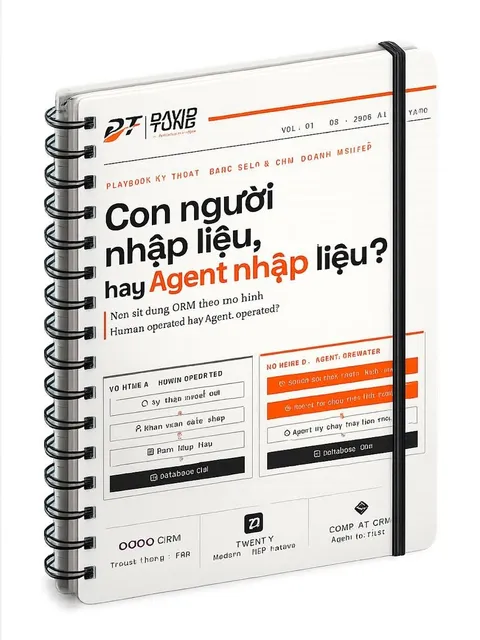
CRM Agentic vs Traditional
Two generations of CRM coexist. One treats humans as data-entry operators with an AI chatbot bolted on. The other treats the agent as the primary operator, with CRM as where the agent stores what it has verified. The difference is not features — it is who holds the steering wheel.
Published: August 7, 2026
“A confidently wrong data point is worse than a blank field — because nobody knows it's wrong.”
Summary
- Every CRM promises clean pipelines, accurate forecasts, no dropped customers. The condition for that promise to hold: someone must sit and enter enough data, correctly.
- Bolting a chatbox onto a data-entry form does not change the operating model. The agentic model inverts the relationship: the agent runs first, humans only handle what the agent won't decide alone.
- MCP standardizes how an AI assistant discovers and calls external system tools. If your CRM has MCP, you don't need to build 'chat with CRM' — you just point your AI client at the endpoint.
- For small businesses and Solo CEOs, the safe thesis is: the agent reads and drafts, humans approve before writing.
Table of contents
- 01
Two models, one root difference
Who is the operator: human or agent
- 02
Anatomy of traditional CRM — Odoo CRM
ORM, forms, permissions, and the cost of opening API
- 03
Twenty — modern CRM, MCP-native
REST + GraphQL + MCP server, Claude skills, Codex plugin
- 04
Comp AI CRM — agentic-first pure
Agent is a separate deployment with its own schedule and queue
- 05
3-dimension comparison table
18 criteria, color-coded, with 'unverified' cells
- 06
MCP — the integration layer that decides the game
Why 'easy to plug into Hermes / ChatGPT / Claude' is a structural advantage
- 07
Context: giants breaking their own interfaces
Agentforce, Headless 360, Agent 365 — with real numbers and sources
- 08
The downside nobody prints on brochures
Prompt injection, MCP vulnerabilities, confident wrong writes, garbage data
- 09
Which to choose — context-based matrix
When Odoo is right, when agentic wins, when to run both in parallel
- 10
4-week roadmap for Solo CEO
From zero to agent auto-updating pipeline, one permission level per week
- 11
Sources & what could not be verified
All URLs, access dates, and acknowledged gaps
Thesis
CRM doesn’t fail because of missing features. It fails because of empty data.
Every CRM promises clean pipelines, accurate forecasts, no dropped customers. The condition for that promise to hold: someone must sit and enter enough data, correctly. That condition is almost never met — and for Solo CEOs, “that someone” is you.
It’s not “has AI” vs “doesn’t have AI”. It’s who sits in the driver’s seat.
Bolting a chatbox onto a data-entry form does not change the operating model. The user still has to open the CRM, still has to decide what to fill in, still is the bottleneck. The agentic model inverts the relationship: the agent runs first, humans only handle what the agent won’t decide alone.
Why MCP is the plug that decides the game
Model Context Protocol standardizes how an AI assistant discovers and calls external system tools. One MCP server declares its tools; any MCP-speaking client can use them — no need to rewrite integrations for each one.
If your CRM has MCP, you don’t need to build “chat with CRM.” You point Hermes or Claude at that MCP endpoint, and the full ability to query and write appears right in Telegram — where you already are.
Operational conclusion
For small businesses and Solo CEOs, the safe thesis is: the agent reads and drafts, humans approve before writing. Just as Comp AI CRM designs it — strong evidence writes directly, weak evidence becomes a suggestion. Full auto-write is a later step, after you’ve seen the agent do it right a few hundred times and have audit logs to review.
Get the full playbook (PDF)
Leave your email — we'll send the full PDF.