Enterprise AI Agent maturity levels: from smart assistants to competitive advantage
A practical executive framework for assessing AI Agent maturity, choosing the right starting point, and embedding AI into core business workflows.
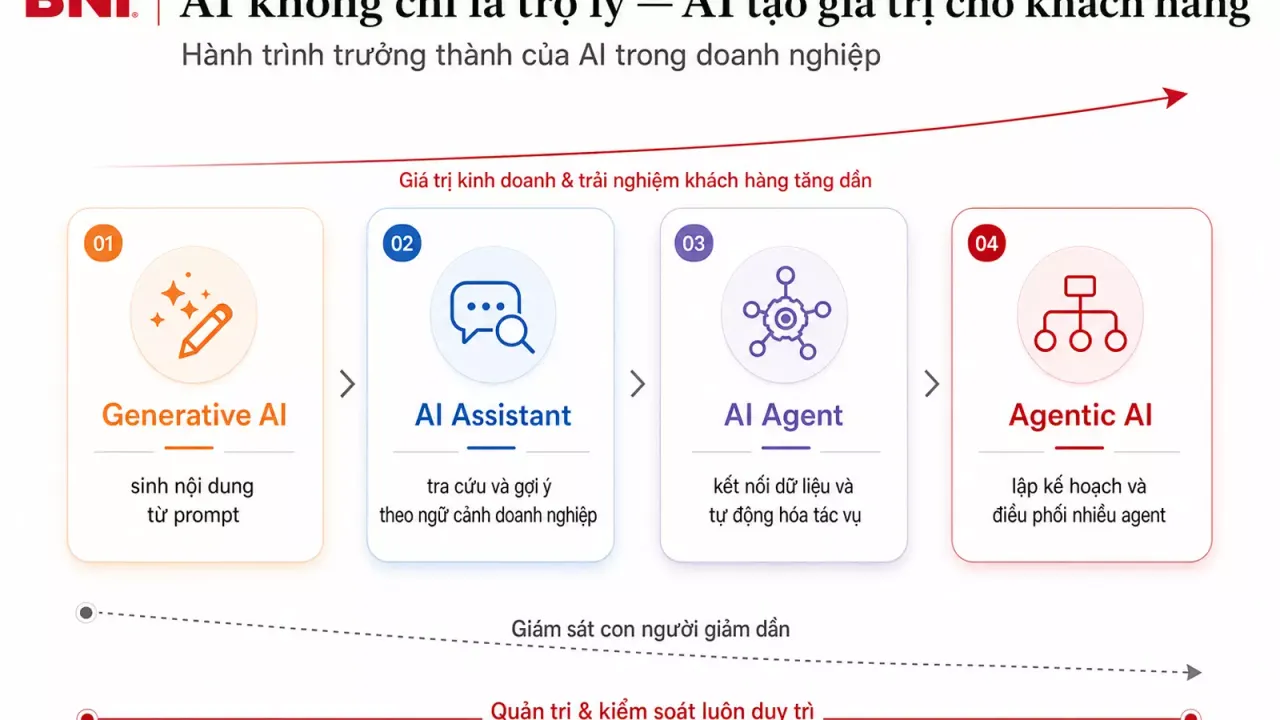
AI is becoming broadly accessible. As tools become easier to use, competitive advantage no longer comes from “using AI”. It comes from turning AI into an operating capability connected to core workflows, enterprise data and customer experience.
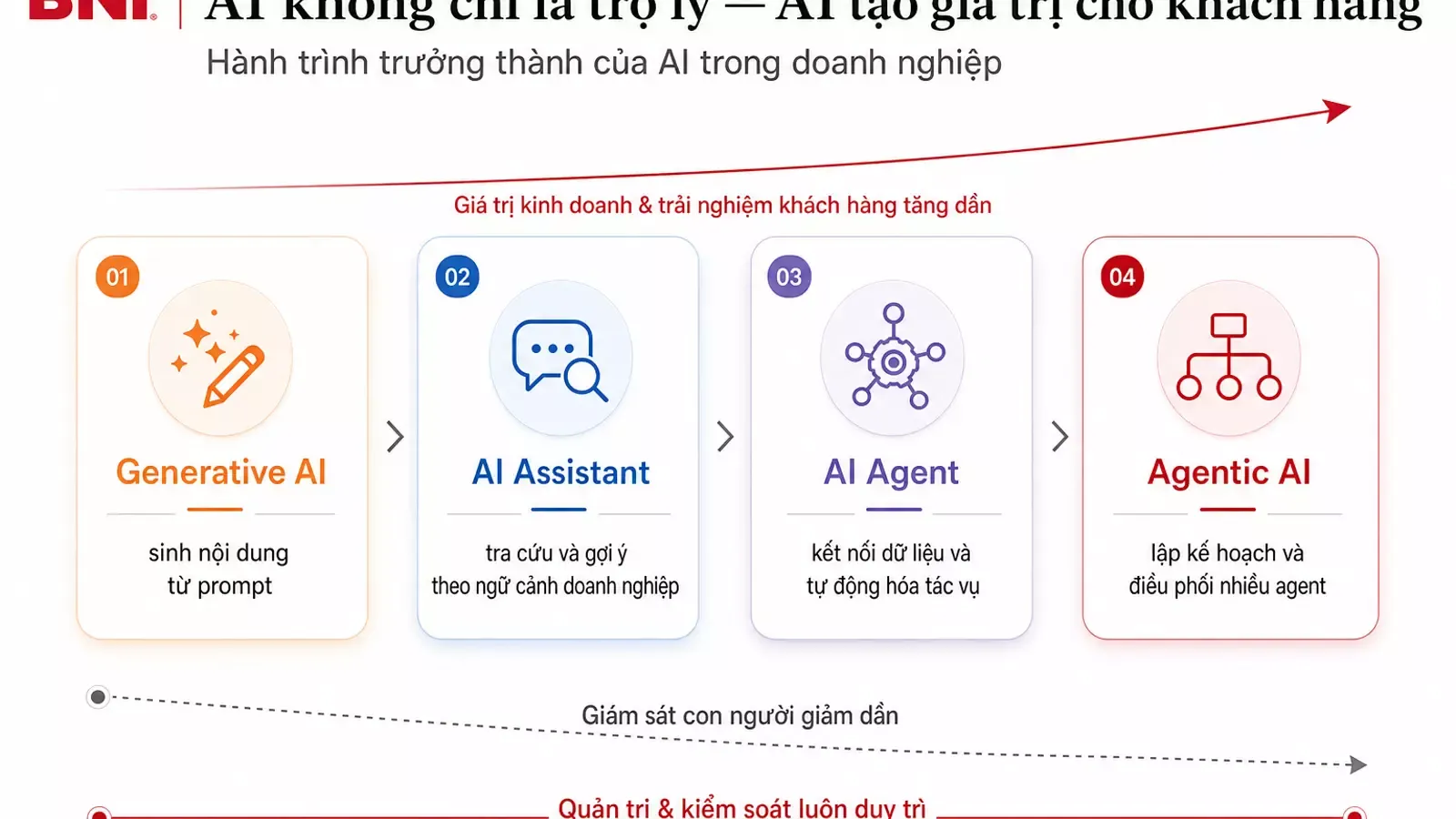
In many conversations with business leaders, one question comes up repeatedly: “Where should we start with AI if we want real business outcomes, not just interesting experiments?”
The short answer: treat AI Agents as an operating architecture, not as a standalone tool.
A chatbot can answer a question. An AI assistant can draft an email, summarize a document or suggest content. But an enterprise-grade AI Agent must go further: understand context, access approved data, coordinate tools, trigger actions and involve human supervision where decisions matter.
This creates a new starting line for businesses. A small group of companies is already moving ahead, while most organizations are still learning how to apply AI at scale. For Vietnamese enterprises, this is an opportunity to leap forward—if AI is implemented as a management and operating system capability, not as a collection of disconnected pilots.
1. Why “using AI” is not enough
Image direction: two companies using the same AI tools; one creates disconnected outputs while the other embeds AI into core workflows. Highlight: advantage comes from operating architecture, not tool access. Technology: GenAI, internal RAG, workflow automation, data governance.
Generative AI is now mainstream. Employees can use tools to write content, translate documents, summarize meetings, analyze spreadsheets or create images.
But when everyone has access to the same tools, differentiation becomes thin. A company cannot build durable advantage simply because its teams write emails faster.
Real advantage appears when AI is embedded into three deeper layers:
- Core workflows: AI participates in activities that create customer value, not only peripheral office work.
- Enterprise data: AI responds and acts based on governed internal data, not generic assumptions.
- Management control: AI has defined roles, permissions, quality standards and escalation points.
In other words, companies do not only need “AI users”. They need to become architects of AI-enabled value creation.
2. Five maturity levels of enterprise AI Agents
Image direction: a five-step maturity ladder from personal tools to an enterprise AI Agent platform, with increasing data, execution rights and governance. Highlight: each level must translate into measurable operating value. Technology: LLMs, AI Assistants, workflow orchestration, tool calling, enterprise agent platforms.
A useful way for leaders to make decisions is to view AI Agent adoption across five maturity levels.
AI Agent Playground
Explore the 5-level maturity model
Move the level to see AI evolve from a personal tool into a governed operating capability.
Workflow AI
AI receives triggers, retrieves data, drafts outputs and updates status.
Shorter cycle time, fewer handoff errors.
Unclear data and process create nice demos that fail in daily operations.
Cycle time, error rate, response SLA
Level 1: AI as a personal productivity tool
Image direction: an employee using AI for drafting, translating, summarizing and slide preparation on a personal laptop. Highlight: faster but fragmented. Technology: ChatGPT/Claude/Gemini, personal prompts, spreadsheet AI.
This is the most common stage. Employees use AI to accelerate personal work: drafting, summarizing, translating, preparing slides or conducting preliminary analysis.
The value is real, but fragmented. Each person works differently. Outcomes are hard to measure, hard to standardize and often dependent on individual prompt skills.
Management question: individual productivity may increase, but is the organization learning anything repeatable?
Level 2: Departmental AI Assistants
Image direction: Sales, Marketing, HR and Finance each have their own AI assistant, still triggered by humans. Highlight: function-specific context. Technology: departmental knowledge bases, RAG, prompt templates, internal chatbots.
At this level, AI is configured for specific functions: sales, marketing, HR, finance, customer service or project management.
Examples include:
- A sales assistant that suggests advisory scripts for different customer segments.
- A marketing assistant that creates content plans aligned with brand messaging.
- An HR assistant that supports employee onboarding.
- A project assistant that summarizes progress, risks and follow-up actions.
AI now has more context, but its primary role is still to suggest and support. Humans turn recommendations into action.
Management question: does the department reduce repetitive work and improve output quality?
Level 3: Workflow AI embedded into processes
Image direction: a customer request flows through CRM, product data, draft quotation and employee alerts. Highlight: AI becomes part of the workflow instead of sitting outside it. Technology: Dify/n8n/Zapier, API integration, CRM, document retrieval, automation triggers.
This is a major transition. AI no longer sits outside the workflow; it becomes part of the workflow.
A customer request can move through several AI-enabled steps: capturing information, classifying needs, retrieving product data, suggesting options, drafting a quote, alerting the responsible employee and updating CRM status.
AI at this level does not necessarily make autonomous decisions. But it can significantly reduce processing time, reduce manual errors and help teams respond to customers faster.
Management question: which repeatable workflow has enough data and would create the greatest impact if processing time were reduced by 30–50%?
Level 4: Supervised AI Agents
Image direction: an AI Agent recommends actions and generates outputs while humans approve high-risk decisions. Highlight: human-in-the-loop enables speed with control. Technology: agent tool use, approval workflows, audit logs, permission control.
At this level, an AI Agent has goals, tools and execution rights within a defined scope.
For example, a sales AI Agent may be able to:
- read customer interaction history;
- assess opportunity potential;
- recommend next actions;
- draft a quotation;
- remind employees to follow up;
- record outcomes in the system.
However, critical points still require human approval: commercial terms, discount policies, implementation commitments or decisions involving strategic customers.
This is the human + AI model: AI moves fast; humans ensure correctness.
Simulate a sales AI workflow
Click through the steps to see the difference between a chatbot and an agent with workflow rights.
Capture need
Customer describes the need via form/chat.
Management question: has the business clearly defined what AI can do autonomously and where human approval is mandatory?
Level 5: Enterprise AI Agent Platform
Image direction: a central AI layer connecting CRM, ERP, executive dashboards, knowledge bases and customer data. Highlight: AI becomes a shared operating capability. Technology: enterprise AI platform, vector database, data warehouse, SSO/RBAC, observability.
At the highest level, the organization has an AI Agent platform connected across departments and systems: CRM, ERP, management operating systems, customer data, operational data, financial reports and internal knowledge bases.
AI is no longer a small project. It becomes a capability layer in the enterprise operating system.
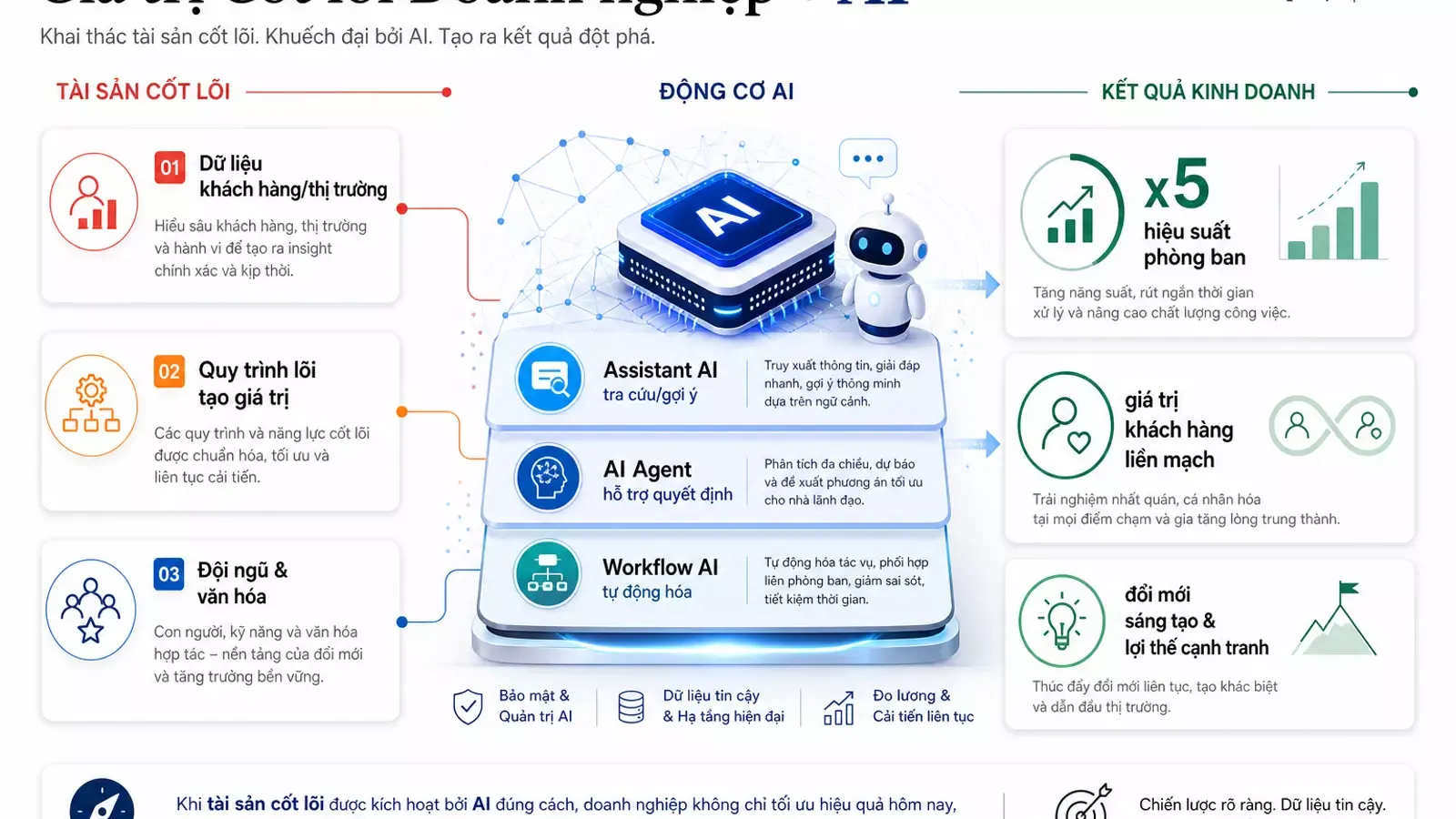
At this level, AI can:
- generate executive reports on demand;
- create early warnings for process issues;
- coordinate tasks across teams;
- support data-driven decision-making;
- personalize customer experience;
- increase operating speed while maintaining control.
The goal is not to “replace people”. The goal is to build an organization that learns faster, coordinates better and serves customers faster.
3. Four principles for implementing AI Agents
Image direction: four implementation pillars: core workflows, small pilots, governed data and human supervision. Highlight: AI deployment must be paired with management discipline. Technology: process mining, data catalog, guardrails, evaluation dashboards.
From an implementation perspective, four principles matter most.
Principle 1: Integrate AI into core workflows
Image direction: a customer value-chain map with bottlenecks highlighted for AI intervention. Highlight: start where value is created, not with a tool list. Technology: BPMN, CRM/ERP integration, process analytics.
Do not start with “Which AI tool should we use?” Start with: “Which process creates the most customer value but is currently slow, fragmented or too manual?”
AI is most valuable when it shortens the path to customer value.
Principle 2: Start with small, repeatable work
Image direction: repeatable tasks like quotations, lead classification and weekly reports standardized into AI checklists. Highlight: small, repeatable and measurable. Technology: automation workflows, prompt templates, form-to-output pipelines.
AI Agent implementation should not begin as an overly broad transformation program. Choose work that happens frequently, uses relatively clear data and has stable output standards.
Examples include:
- drafting quotations;
- classifying leads;
- summarizing meetings;
- checking project progress;
- generating weekly reports;
- supporting employee onboarding.
Once small tasks are standardized, the business can expand to more complex workflows.
Principle 3: AI must follow enterprise data governance
Image direction: AI accesses data through trusted sources, permission layers and anti-hallucination warnings. Highlight: correct data matters more than elegant answers. Technology: governed RAG, RBAC, data lineage, secure connectors.
AI cannot act as an unbounded advisor inside a company. It must know which sources are trusted, which permissions apply, what cannot be inferred and which decisions require validation.
Data, security and access control must be designed from the beginning.
Principle 4: Humans must supervise AI
Image direction: an AI supervision dashboard showing approvals, errors, feedback and learning loops. Highlight: stronger AI needs stronger control. Technology: human-in-the-loop, audit trails, feedback loops, model evaluation.
The more capable an AI Agent becomes, the more important supervision becomes. Companies need to define:
- who is ultimately accountable;
- which outputs require approval;
- how errors are recorded;
- how human feedback is fed back into the system.
Without supervision, AI creates risk. With good supervision, AI becomes a disciplined operating teammate.
4. Strategy example: an AI dealer advisor for Austdoor
Image direction: a 1,000+ dealer network supported by AI to advise homeowners faster and more consistently. Highlight: AI upgrades the dealer channel instead of replacing it. Technology: dealer portal, product recommendation, CRM, quotation automation.
A practical example is the AI strategy for a rolling-door manufacturer with a network of more than 1,000 dealers and partners.
The challenge is not a lack of products. The challenge is advisory speed, consistency of information and the ability to convert homeowner demand into orders through the dealer network.
In the traditional model, a homeowner goes through many steps: contacting a dealer, describing the site, receiving product advice, waiting for a quote, confirming technical details, scheduling a survey and only then moving toward installation. Every slow point in this chain can reduce conversion.
The AI strategy is not designed to replace dealers. It is designed to upgrade dealer capability.
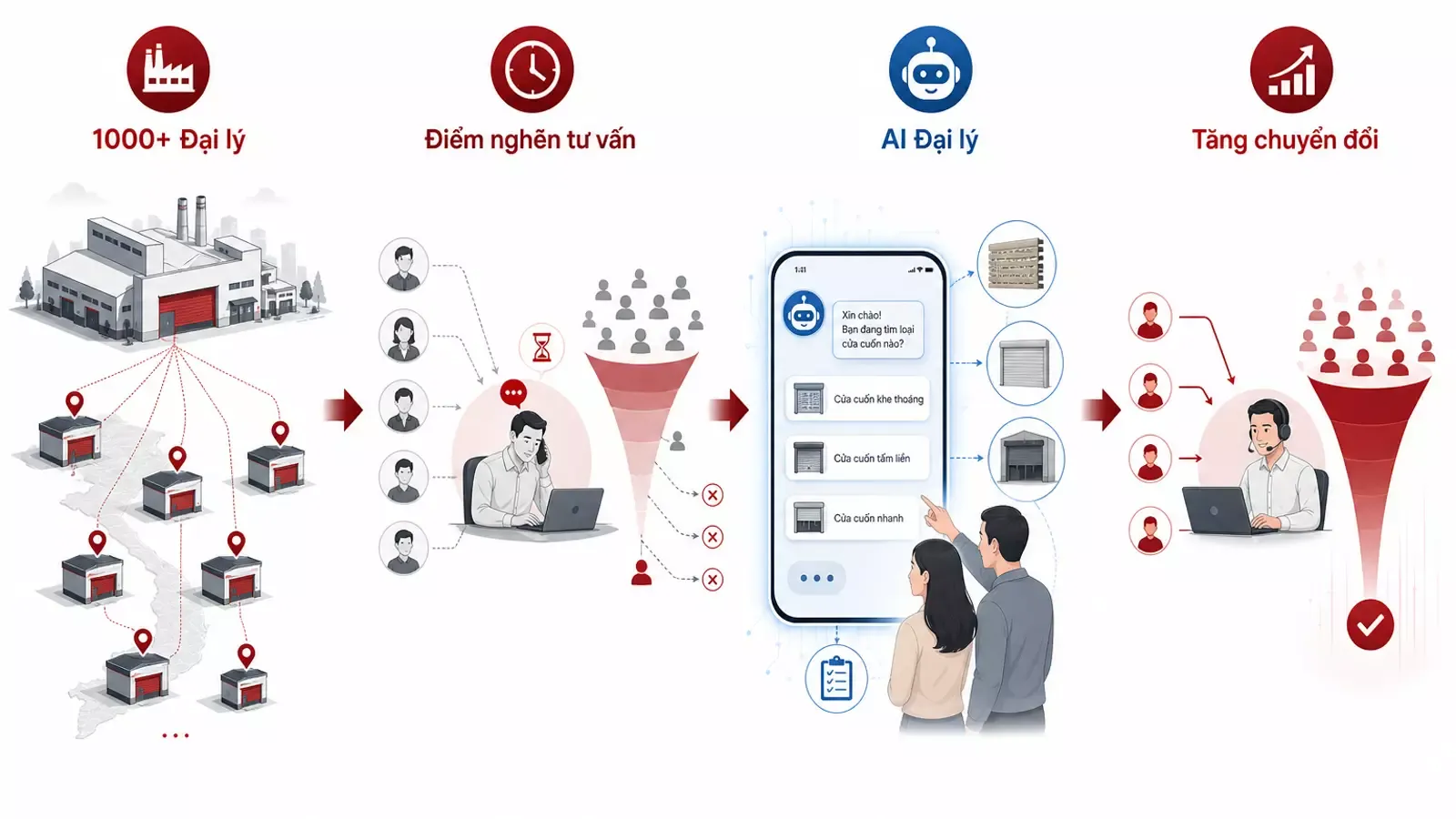
AI Agent as a “co-advisor” for dealers
Image direction: a dealer uses AI on mobile/tablet while advising a homeowner on rolling-door options. Highlight: the co-advisor standardizes product knowledge in every consultation. Technology: mobile AI assistant, product catalog RAG, pricing rules, voice/chat interface.
AI can support dealers in situations such as:
- quickly capturing homeowner needs;
- recommending product groups based on building type, budget, safety and design requirements;
- retrieving standardized technical information;
- creating simple consultation scripts;
- drafting quotations;
- reminding dealers of pre-installation checks;
- capturing demand data so the manufacturer can understand the market better.
The important point is that AI should not operate as an isolated chatbot. It must connect to product data, sales policies, site survey processes, warranty workflows and the dealer/CRM system.
Simulation: an AI Agent advising and drafting quotes automatically in 60 seconds
Image direction: an automated timeline from new lead, data retrieval, option recommendation, draft quote, sales approval and CRM follow-up. Highlight: the agent runs automatically while guardrails and human approval remain in place. Technology: CRM trigger, product catalog RAG, pricing rule engine, approval workflow, audit log.
A quotation AI Agent should not merely “chat well”. It should run as an operating workflow with triggers, trusted data, pricing rules, approval points and audit logs.
Automation demo
Simulate an AI Agent that advises and drafts quotes automatically
Click “run automation” to see a customer request move from new lead to approved quotation and follow-up in about 60 operating seconds.
Lead enters system
Owner: Form / chat / website
The customer submits door size, site photos, location and budget range.
A new CRM opportunity is created with “needs advisory” status.
Check spam, missing photos or required fields.
A good operating pattern is: the customer submits a need, the agent gathers relevant data, recommends options, drafts a quote, routes risky points for human approval and records the full history in CRM. This lets the company respond faster without losing control over price, policy or accountability.
Strategic value
Image direction: three outcome layers: faster response, standardized advisory quality and real-time market intelligence. Highlight: from sales support to competitive capability. Technology: analytics dashboard, conversion tracking, market intelligence, CRM sync.
If implemented well, the company can create three layers of value.
First, faster customer response. Dealers can advise more quickly, more consistently and reduce waiting time for quotations.
Second, standardized advisory quality across the network. A 1,000-dealer network is difficult to manage through manual training alone. AI Agents help bring product knowledge and sales process discipline into every consultation.
Third, real-time market intelligence. Every homeowner interaction can become a signal: where demand is growing, which product groups are asked about most, why deals are lost and whether the bottleneck sits in advice, price, technical confirmation or installation time.
This is the difference between “using AI to answer questions” and “using AI to build competitive capability”.
5. A 90-day roadmap to begin
Image direction: a 90-day roadmap divided into choosing the battlefield, integrating and measuring, then standardizing for scale. Highlight: 90 days is enough to create the first operating capability. Technology: pilot backlog, KPI dashboard, workflow builder, governance checklist.
Companies do not need to wait for a perfect system. A 90-day roadmap is enough to create a practical foundation.
Pick a 90-day starting point
Choose a function and turn the AI idea into a small, repeatable and measurable pilot.
Many leads, slow response
Agent qualifies leads, recommends next steps and drafts quotes.
30–50% shorter response time
First 30 days: choose a focused battlefield
Image direction: leaders select 1–2 priority workflows from a list of operating bottlenecks. Highlight: choose the right problem before choosing the tool. Technology: process inventory, impact-effort matrix, discovery workshop.
- List the 10 most repetitive workflows.
- Select 1–2 workflows with clear impact on customers or executives.
- Define required data, responsible owners and output standards.
- Design a simple AI Assistant or workflow AI prototype.
Next 30 days: integrate and measure
Image direction: AI connects to documents, data and software while a dashboard tracks time, errors and quality. Highlight: measurement reveals whether AI creates real outcomes. Technology: API connectors, vector store, evaluation metrics, event tracking.
- Connect AI to relevant documents, data or software.
- Define what AI can do by itself and what requires approval.
- Measure processing time, error rate, output quality and internal user satisfaction.
- Collect feedback to improve prompts, data and workflow design.
Final 30 days: standardize for scale
Image direction: the new workflow becomes an SOP, supervision checklist and scale-up plan. Highlight: turn the pilot into organizational capability. Technology: SOP knowledge base, access control, training portal, reusable agent templates.
- Rewrite the standard operating process.
- Create supervision checklists.
- Train the core user group.
- Select the next department or workflow to expand into.
- Connect the initiative to the company’s 1-year, 3-year and 5-year strategic picture.
6. Tools are the starting point, not the strategy
Image direction: AI tools such as Dify sit beneath the larger layers of workflow strategy, enterprise data and governance. Highlight: tools accelerate; strategy sets direction. Technology: Dify, LangChain/LangGraph, model gateway, API orchestration, monitoring.
Platforms such as Dify can help companies build AI workflows and agentic applications faster, especially because they can integrate different AI models and third-party systems. This is a strong starting point for organizations that want to learn quickly and customize deeply.
But tools do not replace strategy.
Without core workflows, trusted data, accountable owners and measurement, the company may produce many impressive demos but few real outcomes.
With the right architecture, even a small AI Agent can unlock a new capability: faster reporting, better customer advisory, shorter onboarding, more data-driven decisions and smoother cross-functional coordination.
Conclusion: AI Agents are a new operating capability
Image direction: executives review a new operating map where AI Agents help humans make decisions and serve customers faster. Highlight: AI Agents are an operating capability, not a technology trend. Technology: operating system layer, AI governance, enterprise data fabric, agentic workflows.
Businesses should not treat AI as a technology trend. They should treat AI Agents as a new operating capability, similar to how companies once built management systems, CRM, ERP or executive dashboards.
The destination is not “more bots”. The destination is a company that operates faster, learns faster and creates more customer value.
The strategic question for leaders is no longer: “What can AI do?”
The better question is: “Where in our value chain should AI Agents be placed to create the clearest competitive advantage in the next 90 days?”